The Body Knows First
By Antoinette Smit

When the beauty of movement in flow first dawned on me, I knew it was worth exploring.
So simple, yet also complex.
Movement is life. Anything held in stagnation eventually withers.
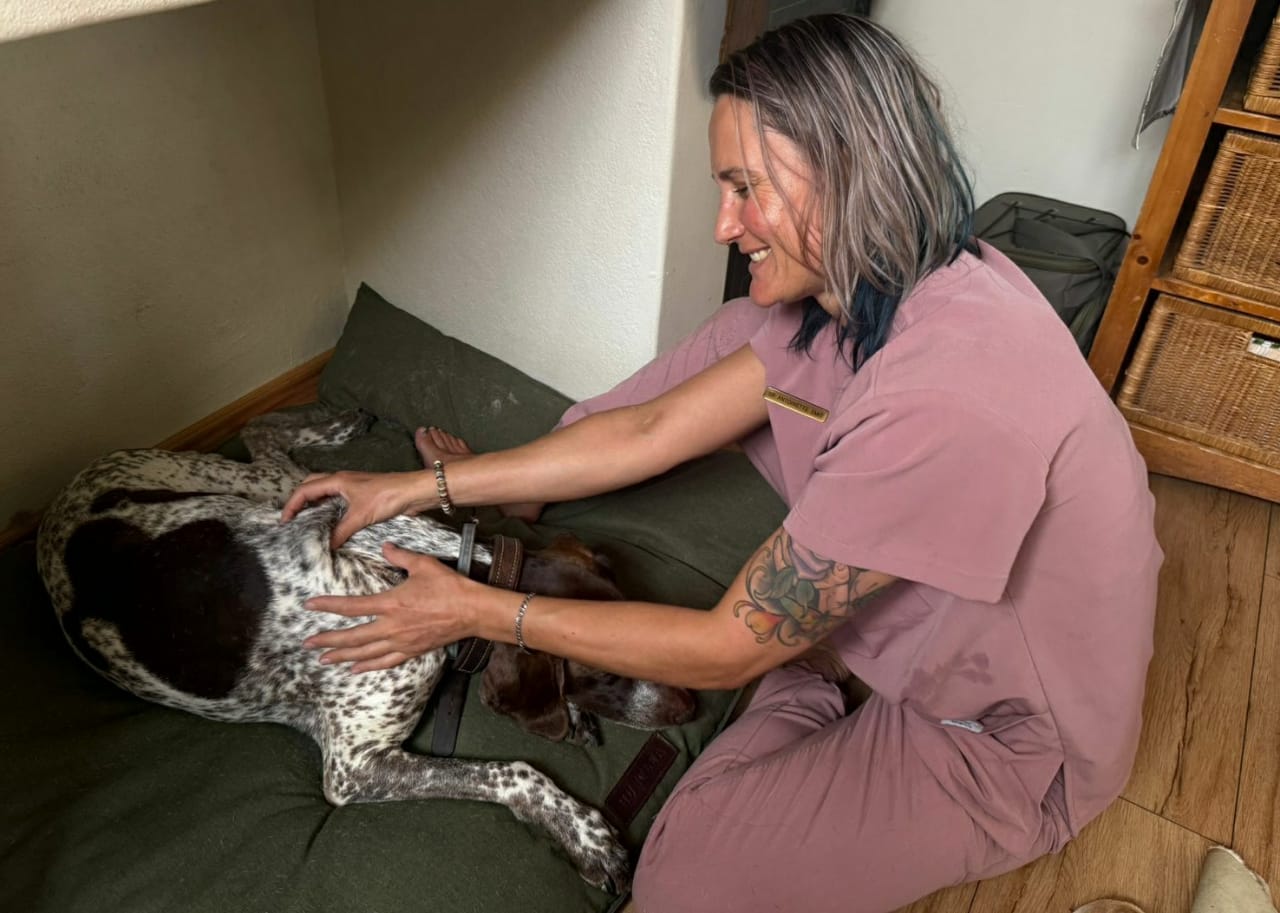
When I am in a quiet space, with my hands on a patient, I feel a deep sense of belonging — a coming home.
There is a moment when the body surrenders in trust, and a subtle alignment settles in.
It is an invitation to feel deeper, to listen and gather information from the body’s profoundly interwoven neurological, musculoskeletal, hormonal, myofascial, and psychological systems.
Trauma, injury, and pain affect all of these systems, disrupting mobility, regulation, and overall function.
Pain is not only a somatic experience that limits movement; it influences psychological wellbeing by shaping nervous system regulation, focus, social engagement, and mood.
Foundations: Life as a Veterinary Nurse
Loving animals, wanting to care for them, and feeling curious about the inner workings of their bodies was a natural state of being for me from childhood.
One day in grade ten biology class, a teacher made an offhand comment along the lines of, “No one gets into Onderstepoort — it’s just too hard.”
I didn’t think much of it at the time. Besides, seven years of studying in Pretoria didn’t feel especially appealing to me.
That changed when I discovered the two-year veterinary nursing diploma on offer. That, I could see myself doing.
I soon realised that Onderstepoort was one of the most stimulating, fun, playful — and slightly naughty — environments for tertiary education.
I will never forget the first day I scrubbed up in the theatre for surgery. It felt as though I had stepped onto a film set — about to take part in something otherworldly.
Being entrusted to assist in reparative procedures, while witnessing the inside of the body firsthand, was profoundly moving.
I loved it so much that after qualifying as a veterinary nurse in 2006, I asked the matron if I could please stay on and work in theatre.
I didn’t realise then how deeply this environment would shape the way I would come to understand bodies, healing, and care.
The Subtle Shift: When Something Different Wanted Space
After spending two years travelling and working as a locum veterinary nurse across various hospitals in London, I found myself back in Cape Town towards the end of 2009.
I knew, in my heart, that something different was asking to be expressed through my career in the veterinary field.
I longed for something more holistic — less noise, more wholeness.
It took months of gently pulling at various threads before I found what felt aligned at that point in time. I met a veterinarian who was running a small practice from her home, offering acupuncture, hydrotherapy, bodywork, and exercise programmes to support animals recovering from surgery or injury.
Three months in, she offered to send me to the University of Tennessee in Knoxville, USA, to complete a fast-track bridging course to become a Certified Canine Rehabilitation Practitioner.
Honestly, all I heard was, “Do you want to go to America to study?”
Of course I did.
At the time, the CCRP course was open only to veterinary nurses, veterinarians, and human physiotherapists, offering these professionals an opportunity to cross over in practice.
In South Africa, veterinary physiotherapy was not yet recognised as a profession by the SAVC, and the term physiotherapy itself was protected by the human physiotherapy council.
We were only permitted to describe our work as physical rehabilitation.
Training Before Training — An Embodied Bridge Between Worlds
Working in theatre taught me focus, precision, discipline, and deep respect for anatomy — but it also circled me back to a growing curiosity about what happened after the incision was closed.
Surgery may be restorative in its intention, yet it inevitably creates its own form of trauma within the body.
I began to realise that my background as a surgical scrub nurse gave me unique insight into the intensity of tissue trauma, pain responses, and recovery timelines.
The two fields started to feel like a marriage between opposites — each naturally complementing the other.
I could feel my hands longing to reconnect with the body following surgery: to gently meet the tissue, reduce pain, and support the healing process.
Historically, many post-operative patients were placed on strict cage rest for weeks — minimal movement, no walking, complete immobilisation driven by fear of further damage.
While well-intentioned, this often resulted in significant muscular atrophy, reduced joint range of motion, stiffness, and ongoing discomfort.
The sooner I could work with a patient after surgery, the clearer it became that the outcomes improved.
Post-operative physiotherapy often begins with simple interventions — cryotherapy, scar tissue massage, gentle joint mobilisation, soft tissue work, and assisted standing.
These small, intentional actions form the foundation for optimal healing.
As the body responds, something else shifts too: confidence returns, nervous systems settle, and animals begin to trust their bodies again.
The Transition: Training, Challenges & Integration
In 2010, CCRP courses were only available overseas.
The University of Tennessee campus was bright, with large classrooms and long, full days. We revisited anatomy and physiology, learned the foundations of physical rehabilitation, and spent hours in practical sessions developing clinical reasoning through hands-on work.
I returned home upskilled and inspired.
Then the real work began.
An invitation to the examinations required the completion of ten comprehensive case studies.
Working full-time in the rehab clinic was demanding, and I found myself quietly questioning my identity.
Had I left nursing — or was I expanding it? I found myself subtly haunted by moments of missing bloodied gloves, the rhythm of breath behind a mask, the privilege of witnessing the inside of the body.
Early the following year, I was driving up the N1 toward Onderstepoort to take on a short locum position as a theatre nurse. Returning to this familiar environment grounded me and allowed me to continue with my case studies with renewed clarity.
It took another year of locum work across Cape Town and welfare settings to refine and submit my case studies. In the months leading up to the final exams, my days often started at 4 a.m. — studying quietly before full, demanding days.
I moved back in with my mum to create the focused space required.
Post-it notes filled the house: muscle names, innervations, modality parameters — reminders everywhere.
In 2012, I travelled to Austria to sit the final written and practical exams alongside the 7th International Symposium in Veterinary Rehabilitation and Physical Therapy.
There was no room for error — travelling that far and failing was not an option.
Soon enough, I found myself wandering the streets of Vienna, watching the famous Lipizzaner horses dance, and doing final revisions for one of the hardest exams I have ever written.
Attending the symposium among international peers and leaders in the field was humbling and deeply restorative.
When I said goodbye to one of the examiners, Dr Darryl Millis, he leaned in and whispered with a smile, “I think you did okay.”
That afternoon, I made a diary entry:
“Happiness is… sitting on a Viennese train, knowing I’ve passed the exams.”
Promulgation of the profession with the SAVC
I was among the first handful of CCRPs in South Africa.
What followed was not a clean entry into a recognised profession with the SAVC.
For many years, veterinary physiotherapy in South Africa existed in a grey area — practised, but not yet formally defined by the council. Alongside other rehabilitation practitioners, we continued working while the profession itself was taking shape.
This involved years of correspondence: submitting course material, documenting work history, logging patients annually, sitting further examinations, and navigating provisional registration processes as regulatory frameworks slowly emerged.
During this time, we worked under temporary registrations and evolving guidelines, holding ourselves to high ethical and professional standards while clarity was still forming. It was demanding, often uncertain work — but it mattered.
Later, formal academic pathways began to emerge, including the establishment of the Equinelibrium College in Plettenberg Bay. With this came clearer routes for future practitioners, even as those of us already working in the industry were assessed under what became known as a grandfather clause.
My specific pathway is no longer available today. It existed only because the profession itself was still being defined. Looking back, I see that period as stewardship — a responsibility to remain within scope, to work with care and transparency, and to serve the profession we hoped would one day stand firmly on its own.
Dual Qualification in Practice
A holistic approach to veterinary care feels essential to me. Looking beyond a single diagnosis or injury, and instead meeting the patient as a whole — a living system rather than a collection of parts — consistently leads to better outcomes. The body is an intricate network of interconnected systems, and respecting that complexity is fundamental to meaningful healing.
I currently work in both roles: as a veterinary nurse in a small local hospital, and as a veterinary physiotherapist running my own mobile practice. I love the integration of these two identities. Rather than competing, they inform and strengthen one another.
During my nursing shifts, I often assist veterinarians by feeling through joints, observing movement patterns, and reviewing radiographs of patients with a range of musculoskeletal pathologies. These conversations frequently lead to referrals, allowing continuity of care beyond the initial diagnosis or surgical intervention.
Supporting recovery through physiotherapy is always a multimodal process. Overall body condition, underlying pathology, body weight, nutrition, medication, exercise, home environment, and behaviour all influence how a patient heals and adapts. No single modality exists in isolation, and meaningful progress depends on recognising the full picture.
Just as important is knowing when to refer a patient. Sometimes they need a reassessment by a surgeon, others require different interventions, and as a physiotherapist, it is my responsibility to recognise those moments and act accordingly.
Nursing and physiotherapy walk alongside one another in my life. Together, they allow me to advocate more fully for my patients — and they make an excellent team.
Reflection
The desire for novelty is what keeps us tenacious and expansive. There is no shame in exploring alternative routes to healing.
We are curious creatures by nature, and this curiosity is worth nurturing. Nurses are intuitive, and often exceptional at recognising patterns — within bodies, behaviours, and environments.
Sharpening these skills not only benefits our patients; it also invites us into deeper embodiment ourselves.
Our hands are intelligent healing tools, and when used with respect, they become powerful instruments of care.
The moment we lay our hands on a patient, we influence their state of being. Following trauma, injury, surgery, or prolonged hospitalisation, animals often need more than technical intervention — they need softness, gentleness, and nervous system regulation through attentive touch.
Healing emerges through clear attunement with the animal who depends on us for care. We are there to nurture, serve, protect, and relieve pain.
Staying devoted to this calling is best supported through a multimodal approach — one that honours the whole being rather than a single diagnosis.
Perhaps it is time we begin looking at our animals through a fresh lens, bringing them into focus with greater wholeness.
Closing — Coming Home to Self
Seated on the floor, hands resting on a patient’s body, I lean into a state of grounded presence.
Animals have a way of healing us in return, if we allow the resonance to emerge.
I have arrived at home visits carrying my own private battles — pain woven quietly into the fabric of my heart.
Through training, self-awareness, and nervous system regulation, I learn to arrive calm and grounded, offering safety before asking for trust.
And yet, there are sessions where enough safety is created for something deeper to unfold — moments of shared stillness between myself, the client, and the patient.
In those moments, my own weary heart is given permission to soften, to open, to breathe.
What returns to me is unexpected nourishment: a settling of my own nervous system, a reminder of why this work matters. Healing, I have learned, does not move in a single direction, nor does it unfold linearly. It circulates — creating a quiet feedback loop that ripples outward, carrying the wonder of restoration with it.